Sanjo and Shijo Bridges: The Two Ends of Pontocho
 By Max R., last reviewed , 4 min read
Pontocho begins and ends at a bridge. At the north end is Sanjo Bridge, once the finishing line of the road from Edo. At the south end is Shijo Bridge, which carries Kyoto's busiest shopping street across the river to Gion. Both have stood on these spots for centuries, and both are worth a few minutes before you step into the lane.
Sanjo Bridge (三条大橋)
The end of the road from Edo
For most of the Edo period (1603–1868), Sanjo Bridge was where the great highways from the east arrived in the capital. Both the Tokaido, the coastal road from Edo (today's Tokyo) with its famous fifty-three post stations, and the inland Nakasendo finished here. Travellers who had walked for two weeks or more crossed the river on this bridge and stepped into the city.
The bridge was important enough to be a kogi-bashi, a bridge maintained by the shogunate itself. When floods carried it away, which happened often, it was rebuilt at government expense.
Hideyoshi's stone pillars
A bridge has crossed the river here since at least the fifteenth century, but the decisive rebuilding came in 1590, when the warlord Toyotomi Hideyoshi ordered it remade on stone pillars. According to the City of Kyoto, it was the first bridge in Japan built on stone piers, at a time when most bridges stood on wooden posts.
The present bridge dates from 1950, but it keeps a link with Hideyoshi's: some of the bronze giboshi, the onion-shaped finials on the railing posts, are old ones, and a few carry inscriptions from the Tensho era of the 1590 rebuilding. Have a close look at the posts as you cross. Local lore says that the nicks on one of them, the second post from the west end, are sword cuts from the Ikedaya Incident of 1864, when the Shinsengumi police raided a nearby inn full of anti-shogunate activists. It is a good story; there is no firm evidence for it.
Statues at either end
At the west end of the bridge stands a statue of Yaji and Kita, the two comic travellers of Tokaido Hizakurige, a hugely popular nineteenth-century novel about walking the Tokaido. Arriving at Sanjo was the end of their journey too. At the east end, outside Keihan Sanjo Station, is the kneeling figure of Takayama Hikokuro, an eighteenth-century scholar shown bowing towards the Imperial Palace. Kyoto people call it the dogeza-zo, "the kneeling statue", and it is one of the city's classic meeting points.
The view
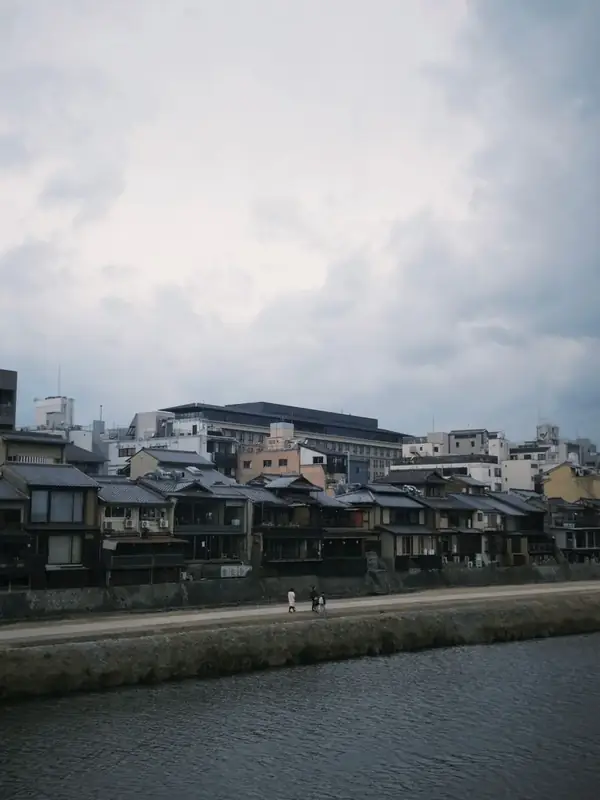
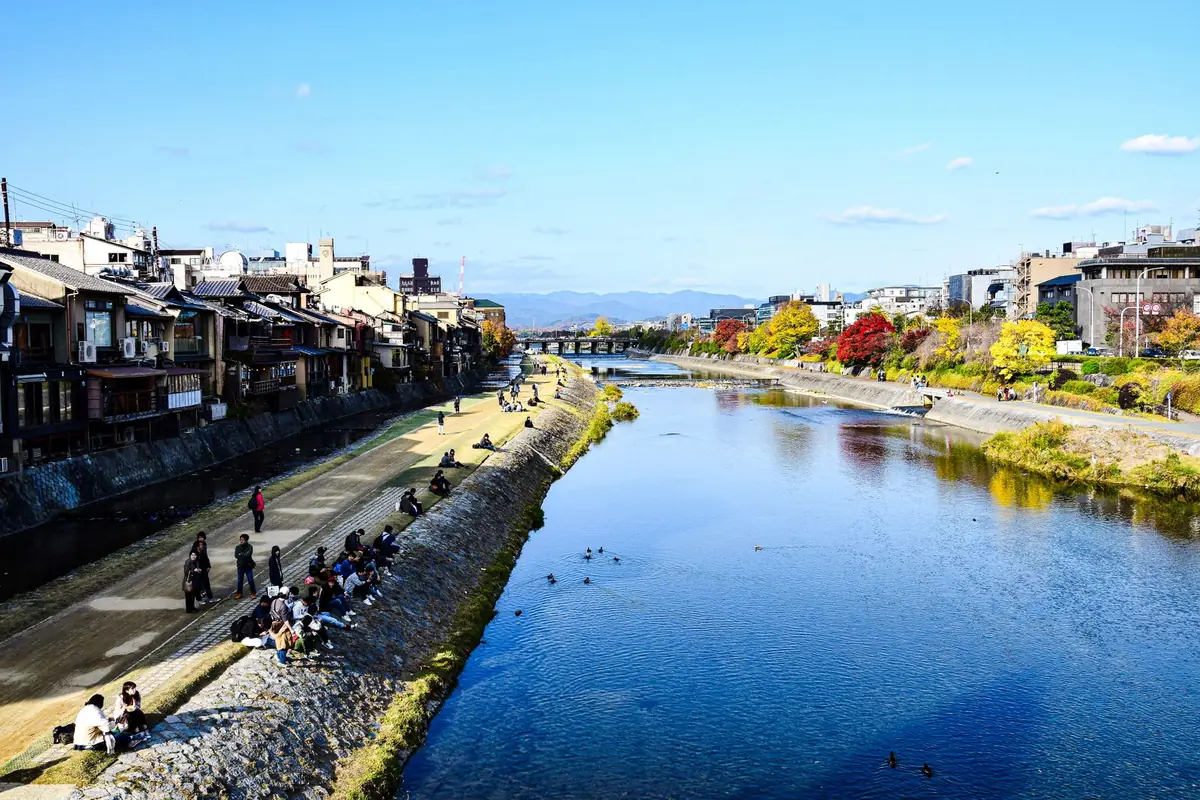
From the middle of Sanjo Bridge, look north up the river towards the mountains, or east to the Higashiyama hills. It is the start of our sunset walk, and in the hour before dusk it is one of the best places in central Kyoto to watch the light change.
Shijo Bridge (四条大橋)
A bridge to Gion
Shijo Bridge links Shijo-dori on the west bank with Gion and Yasaka Shrine on the east. For centuries it was closely tied to the shrine, and it still plays a part in the shrine's festival: during the Gion Matsuri, a portable shrine is carried onto the bridge on 10 and 28 July and purified with water from the Kamo River.
The crossing has been rebuilt many times. A bridge built in 1857 was replaced in 1874 by an iron bridge, one of the early signs of modern Kyoto, and the present concrete bridge opened in 1942. It proved its strength early: after the great flood of 1935, Shijo Bridge was one of only a handful of Kamo River bridges that could still be used.
Where kabuki began
The dry riverbed around the bridge was once a public stage. In 1603 a performer named Izumo no Okuni drew crowds here with a new, daring style of dance, and her performances are remembered as the beginning of kabuki. A statue of Okuni now stands at the east end of the bridge.
Next to it is the Minamiza, a kabuki theatre whose licence dates back to the early seventeenth century. It is often described as the oldest theatre in Japan still operating on its original site. The current building opened in 1929. In December its front is hung with wooden name boards for the year-end kaomise performance, and you can see them from the bridge.
The view
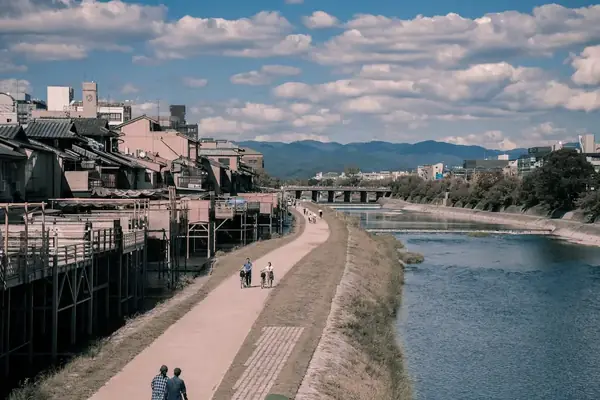
Stand on the north side of Shijo Bridge and look upstream: the long row of buildings on your left is the back of Pontocho. From May to mid-October their dining platforms stand over the bank, and in the early evening, with the lights coming on, this is the classic view of the district.
Between the two bridges
The two bridges are about half a kilometre apart. You can walk between them through Pontocho itself, along Kiyamachi beside the Takase River, or down on the riverbank. Doing all three, one after another, is a very good way to understand how the district fits between its two rivers. For longer walks along the water, see Walking the Kamo River.