The Pontocho Kaburenjo: The Theatre at the End of the Lane
 By Max R., last reviewed , 4 min read
Walk into Pontocho from Sanjo-dori and the first large building you pass is not a teahouse or a restaurant but a theatre. The Pontocho Kaburenjo is where the district's geiko and maiko rehearse and where they perform for the public each spring and autumn. Most people walk straight past it, which is a pity: it has a good story, and an odd figure on the roof.
What a kaburenjo is
Kaburenjo (歌舞練場) means, roughly, "hall for practising song and dance". Each of Kyoto's geisha districts has, or has had, a hall like this. It is a school and rehearsal space first: the place where maiko learn dance and music and where geiko keep up their skills. A few times a year it becomes a public theatre.
The Pontocho Kaburenjo is run by the Pontocho Kabukai, the association of the district's teahouses, geiko and maiko, which also organises the Kamogawa Odori.
The building
The present theatre was completed in 1927, after building work that began in 1925. It was designed by Kimura Tokusaburo of the Obayashi construction company, a specialist in theatres whose earlier work included the Shochikuza in Osaka, with the architect Takeda Goichi as design adviser. Built in reinforced concrete, with four floors above ground and a basement, it was praised at the time as modern architecture with an Eastern flavour.
The building has been altered over the years. According to the City of Kyoto's description, the stage and seating were rebuilt in concrete in 1933, and in 1953 the traditional floor seating was replaced with chairs and the building was extended towards the river.
From the lane, look at the tiled roofs and the heavy, almost castle-like walls, unusual among the slim wooden townhouses of Pontocho. Then look up: on the roof is a guardian figure modelled on the mask of Prince Lanling (Ranryo-o), a character from bugaku, the ancient court dance. According to the Kabukai, he watches over the prosperity of Pontocho.
What is performed here
The Kamogawa Odori in May
The main public event of the year. For most of May, the geiko and maiko of Pontocho stage the Kamogawa Odori, a programme of dance drama and pure dance with live music, usually with three shows a day. Some tickets include a tea ceremony served before the show. Our Kamogawa Odori guide covers dates, seats and tickets.
The Suimeikai in autumn
In autumn the district holds its recital, the Suimeikai. It is smaller and more formal than the spring dances, a showcase of the dancers' and musicians' skill rather than a large stage show. Dates and tickets are announced by the Kabukai each year.
Other events
The theatre can also be hired for traditional music and dance, concerts, lectures and recitals, and its upper floors are used for rehearsals and exhibitions. Outside performances and events, the building is generally not open to visitors.
Seeing the Kaburenjo
- From the lane. The theatre is a minute's walk south of Sanjo-dori at the north end of Pontocho. Stop at the side of the lane, not in front of the entrance, and do not go inside unless there is a performance.
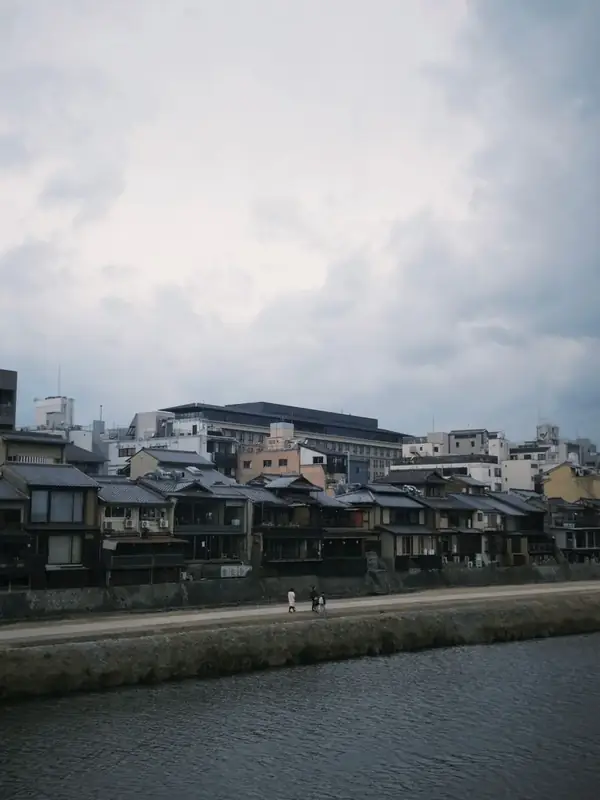
- From the river. The theatre's river side is visible from the east bank of the Kamo River, near Sanjo Bridge.
- At a performance. The only way to see the inside. Tickets for the Kamogawa Odori go on sale in spring on the official website.
The Kaburenjo is also where our sunset walk enters the lane. If you start at Sanjo Bridge, it is the first landmark you pass on the way south to Pontocho Park.